

Bulk Dental Floss Pick Exporter for Quality Oral Care Products Worldwide
2026-09-23
If you’ve ever waited weeks for a floss pick shipment only to find half the batch bent or poorly threaded, you know the pain. Bulk oral care sourcing shouldn’t be a lottery. That’s where KLDZS comes in—a bulk dental floss pick exporter built on consistent quality, on-time delivery, and real accountability to customers worldwide. In this guide, we’ll show you what separates a dependable floss pick supplier from the rest, and how KLDZS keeps your shelves stocked with products people actually want to use. Ready? Let’s dig in.
What a Bulk Floss Pick Order Actually Looks Like from the Factory Side
When a bulk floss pick order lands in the factory system, the first thing that happens isn't production—it's a spec check. Our account manager pulls the exact SKU, material grade, and packaging requirement from the PO and walks it over to the injection molding supervisor. They go down a checklist: handle color, floss tensile strength, pick shape, whether the customer wants individually wrapped pieces or loose in a jar, and how many units per export carton. A 500,000-piece order might sound huge, but on our floor it's roughly two days of run time across six machines, assuming no mold changeovers.
The actual molding comes next. Bulk floss picks are usually run on 8-cavity or 16-cavity molds. The operator sets the barrel temperature, injection pressure, and cooling time based on the resin—most orders use food-grade PP or ABS. As the parts drop into bins, a line worker does an hourly visual check for short shots, flash, or bent floss arms. The floss itself is loaded onto a spool feeding mechanism; if it snaps mid-run, the whole cavity stops and the pick gets rejected by a sensor. That's the part most buyers never see: for every 100 picks that ship, maybe 4 or 5 were tossed during production or QC.
After molding, the picks move to packaging. If the buyer wants retail-ready blister cards, that adds a separate heat-sealing step. For true bulk orders—say jars of 1,000 or plain polybags of 500—the process is faster: weigh-counting machines portion the picks, then sealers close the bags with a batch code and lot number printed on the side. Pallets get stretch-wrapped and labeled with the purchase order reference, carton dimensions, and gross weight. A 40-foot container can hold about 2.8 million loose floss picks if they're packed tight, but most customers order in the 300,000 to 800,000 range to balance freight cost and warehouse space.
Where Quality Slips in High-Volume Dental Floss Production
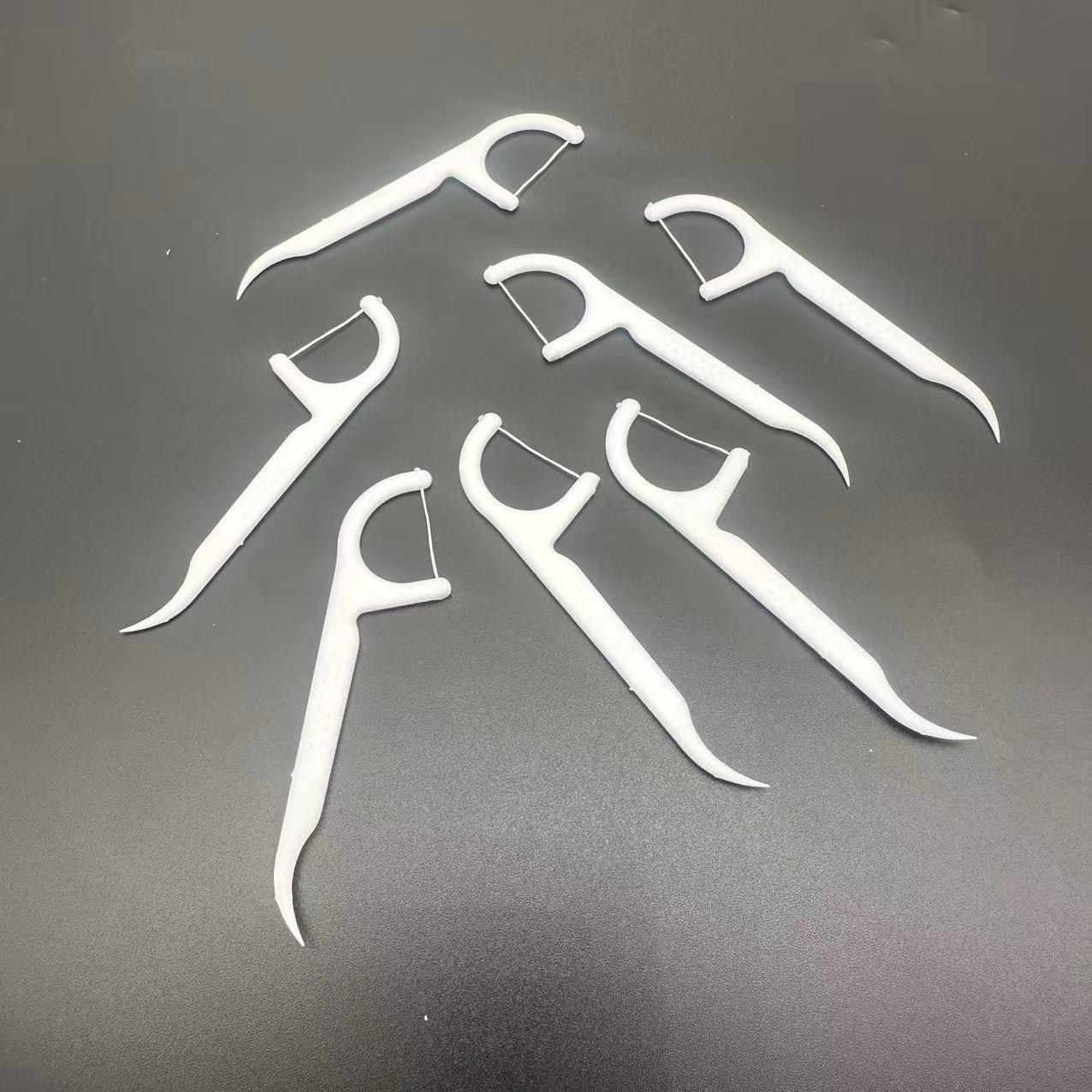
When dental floss lines run at full tilt, the first casualty is often the raw polymer blend. To keep extruders humming, batches get stretched with regrind and lower-grade nylon, which alters tensile strength and leaves micro-abrasions on the filament. Operators rarely catch this until spools hit the winding stage, where snapped strands and fuzzy edges signal that the material drifted far from the original spec.
Another quiet failure point is the wax coating step. High-speed lines tend to thin the coating or skip the second pass to meet shift quotas. The result is floss that squeaks against teeth, frays on tight contacts, or loses its glide halfway through a spool. Incoming inspection often misses this because sample pulls happen at the start of a run, not after hours of thermal drift in the coating bath.
Finally, packaging automation introduces its own set of defects. Pick-and-place arms calibrated for one spool size can crush flatter profiles, while heat-sealed pouches trap moisture that degrades the wax. Pallets leaving the warehouse may look uniform, but the variance per carton means a hygienist in one clinic gets silky, robust floss while another wrestles with brittle, snapping thread from the same lot.
How Smart Exporters Handle Packaging Rules Across Different Countries
Smart exporters start by building a packaging rule matrix before design work begins. Instead of treating foreign packaging requirements as a final hurdle, they map destination countries against factors like material bans, label languages, recycling symbols, and dimensional limits. A shipment to Germany might need Green Dot licensing, while the same product sold in California carries Proposition 65 warnings. Keeping this matrix updated by local agents or distributors prevents last-minute repacking costs.
They also standardize the core package structure but leave room for localized overlays. For example, a folding carton can share one dieline across five markets, while each run swaps in country-specific compliance panels, barcode placements, and font sizes for mandatory text. This keeps tooling costs down and lets small batch changes happen without a full redesign.
Finally, experienced exporters validate packaging with local labs or trade associations before committing to large print runs. They send physical samples to test humidity resistance in Southeast Asia, check ink migration limits in the EU, or confirm that a bottle cap meets child-resistant standards in North America. This pre-shipment check avoids border rejections and shows buyers that the exporter understands local rules better than competitors.
Why Some Floss Picks Feel Better Than Others and How to Specify It
The difference usually comes down to three physical characteristics: the stiffness of the pick, the texture of the floss, and how the handle sits between your fingers. A pick that bends too easily gives you no leverage against tight contacts, while one that's overly rigid can jab the gumline. Similarly, floss that feels waxy or coated tends to slide rather than squeak, but if the coating is too thick it fails to grab plaque. The handle's shape matters just as much—too thin and it digs into your thumb, too smooth and it slips when wet.
When writing a spec, don't rely on vague terms like "comfortable" or "strong." Instead, call out measurable details: floss filament material, breaking strength in newtons, pick tip radius, handle thickness at the pinch point, and surface finish. For example, a handle with a matte texture and a thickness around 4–5 mm at the grip area will feel more secure than a glossy 2 mm stick. Ask suppliers for samples across a range of stiffness values and have multiple people rank them blind—what feels "premium" in one hand often feels flimsy or harsh in another.
The Cost of Cutting Corners on Floss Pick Materials
Cheap floss picks often snap at the worst moment. A brittle polypropylene blend might save a few cents per unit during manufacturing, but it turns a simple cleaning routine into a frustrating game of picking plastic shards out of your gums. That tiny fracture isn't just an annoyance; it means another pick gets tossed, another pack gets opened sooner, and any upfront savings quietly disappear.
There's also the issue of floss tension. Low-grade materials can't hold the strand taut, so the floss frays, slips, or bows under pressure. You end up sawing at the same contact point repeatedly, which does little for plaque removal and can irritate the gum line. Over time, the real cost shows up in wasted minutes, a half-used bag of useless picks, and maybe an extra trip to the dentist.
It's not about luxury, just basic function. A slightly denser polymer or a better-tensioned monofilament costs more upfront, but it keeps the pick from becoming single-use in the wrong way. When a product fails at its only job, the discount isn't a deal; it's a penalty wrapped in plastic.
From Container to Checkout What Happens After Floss Picks Leave Port
Once the container is offloaded at the port, a drayage truck hauls it to a nearby bonded warehouse. Customs officials may flag the shipment for a random inspection, which can add a day or two to the timeline. After clearance, the cartons of floss picks are scanned into a regional distribution center, where they sit on pallet racks until a retail order pulls them into the picking queue.
Inside the distribution center, workers break down the master cartons and repack the floss picks into smaller totes destined for individual stores. This is where hiccups often happen: a backlog in the sortation system or a shortage of outbound trailers can strand the product for an extra week. When a truck finally departs, it might follow a milk run that drops off mixed loads at several pharmacies and grocery chains in one night.
At the store, a receiving clerk checks the delivery against the manifest and wheels the totes to the health and beauty aisle. An overnight stocker opens each tote, hangs the floss picks on a peg hook next to the interdental brushes, and updates the shelf label. By morning, the product is ready for a shopper to toss into a basket and later scan at the front-end register.
FAQ
We ship bulk cartons of single-use dental floss picks in various handle shapes and floss strengths, all intended for retail repackaging, dental clinics, and hospitality use.
Our standard line uses food-grade polystyrene for the handles and high-tenacity nylon or polyester for the floss. We also carry a plant-based PLA option for buyers who want a lower plastic footprint.
Yes. We offer custom color matching on handles, logo imprinting on individual wraps or pouches, and tailored outer carton designs. Usually the artwork setup takes three to five days before sampling.
For standard designs, we generally start at 50,000 pieces per shipment. Custom colors or private label packaging may push the minimum to 100,000 pieces depending on the mold and printing requirements.
Each pick is sealed in hygienic film or a paper sachet, then packed into reinforced corrugated cartons with moisture barriers. We run drop tests and container loading checks before every export batch.
Absolutely. We prepare the commercial invoice, packing list, certificate of origin, and any required health or safety certificates. We can ship FOB, CIF, or DDP depending on what works best for your country's import rules.
Yes, we can send 20 to 50 free samples of our stock designs. If you need custom samples with your logo, there's a small tooling and courier fee that gets credited back when you place the bulk order.
Conclusion
When a bulk floss pick order lands at the factory, it rarely matches the tidy sample sets buyers remember. Raw resin lots arrive in mixed batches, mold cavities wear unevenly, and line speeds get pushed to meet shipping deadlines. The first place quality slips is in the floss itself—tension drifts, knots form, or the filament frays where it meets the handle. That's why experienced exporters insist on cavity-numbered inspection sheets and random pull tests during the run, not just a final once-over. Packaging adds another layer: what passes in one market may be rejected in another, from label languages and recycling symbols to child-resistant blister requirements. A smart exporter keeps a matrix of packaging rules per destination and treats it as a living document, not a one-time checklist.
The feel of a floss pick in the hand mostly comes down to material choice—nylon vs. polyester floss, ABS vs. PS handles, soft-touch overmold or none. Buyers who specify "smooth and flexible" without a measurable standard end up with whatever the factory has on hand. Smart specifications include durometer, flex modulus, and a reference sample for tactile approval. Cutting corners on material—say, switching to recycled resin with inconsistent melt flow or thinning the pick's neck—might save cents per unit but returns in broken picks, frayed floss, or even customer injury claims. After the container leaves port, the exporter's job isn't done. Humidity in transit can warp handles, customs holds can stall inventory, and retail shelf damage from rough unpacking affects brand perception. Exporters who track condition at multiple hand-off points and share that data with buyers catch problems before they reach the checkout aisle.
Contact Us
Contact Person: Caiju Zhang
Email: [email protected]
Tel/WhatsApp: +86 14763963294
Website: https://www.kldbrush.com