

Busbar Insulator Supplier: What to Look for in Quality Components
2026-09-19
A busbar insulator may look simple, but choosing the wrong supplier can lead to failures that ripple through your entire electrical system. Before you sign off on the next batch, it's worth knowing which quality markers separate dependable components from risky ones. As a supplier that has fielded countless replacement calls, MOLDVOLT shares the key checks that many buyers overlook.
Material Formulations That Resist Tracking and Erosion
Silicone rubber and certain cycloaliphatic epoxy grades form the backbone of many tracking-resistant compounds because they leave minimal carbon residue during dry-band arcing. Adding alumina trihydrate at loadings between 30 and 60 phr strengthens this behavior: the filler decomposes endothermically, releasing water vapor that cools the surface and dilutes flammable gases before they can char. The exact ratio shifts with the pollution severity and the gland or housing design, but the mechanism stays consistent—deny the arc a conductive path.
Filler shape and dispersion are just as important as chemistry. Platelet fillers like mica or calcined talc force leakage currents to travel a longer, more interrupted route, slowing carbon track formation. In outdoor insulation, pairing alumina trihydrate with fumed silica often outperforms either alone. The silica raises melt viscosity under heat, keeping the surface layer from flowing into a tracking path, while the ATH supplies the quenching reaction at the hot spot.
For epoxy and unsaturated polyester systems, halogen-free packages built around ammonium polyphosphate or melamine cyanurate—often with a small amount of red phosphorus—disrupt the radical chain reactions that convert polymer into conductive char. A formula that passes a 600 V CTI test in clean conditions can still fail in the field if filler distribution is uneven, so mixing speed, order of addition, and surface treatment of the fillers become part of the formulation itself, not an afterthought.
Dimensional Accuracy You Can Measure on Every Batch
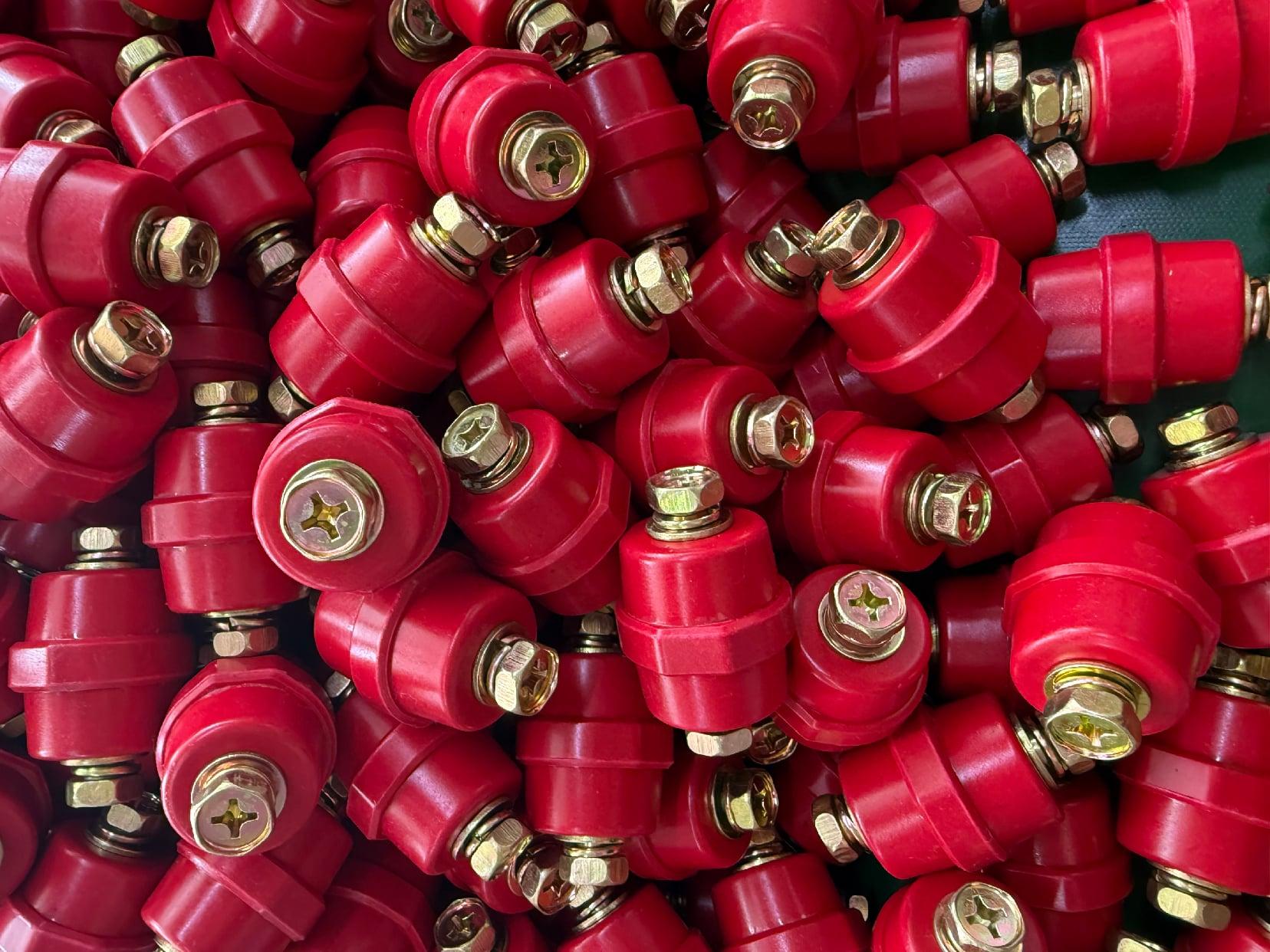
A caliper check on the first article doesn’t tell you much about the hundred parts behind it. We sample from the middle and end of every run, not just the setup piece, and record the actual readings for each batch. That sheet travels with your order, so what you measure at receiving is what we measured before packing.
The real difference is in how we fixture the part during inspection. Each batch is checked in a holding jig that mimics the mating surface on your product, reducing the false confidence that comes from measuring a free-floating part. If any critical dimension moves beyond the agreed tolerance, the entire batch is held back and corrected.
This isn't about impressive-looking inspection reports; it's about catching drift before it reaches your dock. You can pull any part from the box, compare it to the batch sheet, and see the same numbers within the tolerance band.
Thermal Performance Under Repeated Load Cycling
Repeated load cycling introduces a complex thermal signature that cannot be captured by steady-state measurements alone. Each cycle drives transient temperature gradients across the junction, die attach, substrate, and baseplate, causing thermal expansion mismatches at every interface. Over thousands of cycles, these differential strains accumulate, leading to void coalescence in solder layers, delamination along bond lines, and a measurable rise in junction-to-case thermal resistance. The degradation is rarely linear; early cycles often show negligible change, followed by a sharp knee in the thermal impedance curve as microcracks propagate enough to restrict heat spreading.
What makes thermal behavior under cycling truly distinctive is the interplay between power dissipation profile and dwell time. Short, high-current pulses generate rapid self-heating that stresses the near-junction region, while longer off-times allow partial recovery of creep deformation in solder and sintered silver layers. Inverter-grade modules tested with 15-second on/off cycles at 80% rated current exhibit a 25-40% increase in thermal resistance after 8,000 cycles, yet the same modules loaded with 2-second pulses at identical average power show only a 10% shift. This points to a frequency-dependent failure mechanism where thermal capacitance, not just resistance, governs the rate of structural deterioration.
Field data from traction and renewable energy converters confirms that peak junction temperature excursion, not average temperature, is the dominant driver of thermal fatigue. Modules cycling between 40°C and 150°C fail significantly earlier than those holding near 125°C despite higher average temperature, because the strain energy density per cycle scales with the square of the temperature swing. To manage this, designers now rely on transient thermal impedance curves extracted from power cycling tests, combined with rainflow counting of mission profiles, to predict remaining useful life. The practical takeaway is clear: thermal derating under cyclic load must account for temperature amplitude, ramp rate, and dwell asymmetry—not just the steady-state case temperature printed on the datasheet.
The Difference Between a Certificate and a Test Report
Many people use these terms interchangeably, but they serve distinct purposes in quality assurance. A test report is essentially a record of measurements and observations produced by a laboratory. It lists the methods used, conditions, and raw results, but it does not by itself state whether the product passes a particular standard.
A certificate, on the other hand, is a formal document issued by a certification body that attests a product, system, or person meets specified requirements. It relies on one or more test reports as evidence, but goes further by making a conformity decision. The certificate usually names the standard, the scope, and validity period.
In practice, you may need both. Buyers and regulators often request the test report to see the actual data, while the certificate provides a quick declaration of compliance. Confusing them can lead to accepting incomplete documentation.
Custom Designs That Keep Creepage Distances Intact
When standard layouts fall short, custom board geometries step in. Rather than forcing traces into crowded clearances, designers reshape isolation barriers and reroute high-voltage paths so the required creepage distance never gets compromised. Small adjustments like milled slots, added ribs, or repositioned components create physical separation that holds up under real operating conditions.
These tailored approaches also account for contamination and altitude, not just nominal spacing. By widening gaps in critical zones and using conformal coating selectively, the design keeps surface leakage currents in check. The result is a board that meets safety requirements without sacrificing functionality or forcing a larger footprint than necessary.
How Transparent Suppliers Handle Incoming Raw Material Checks
A transparent supplier treats incoming raw material checks as the first real line of defense, not just a box to tick. Instead of relying on a single person's judgment, they use a rotating team approach where two different inspectors evaluate the same shipment against a detailed checklist—one focusing on physical attributes like color, texture, and weight, the other on documentation and certificate of analysis. Any mismatch, even minor, is logged with photos and timestamps before the batch moves forward.
What sets truly open operations apart is that they invite customers to witness or audit these checks without prior notice. They keep a live dashboard showing incoming lot numbers, supplier history, and pass/fail trends, so problems are visible before they become downstream issues. When a batch fails, the supplier doesn't hide it—they quarantine the material, notify the buyer within hours, and share the root-cause investigation along with corrective action taken at the source.
Transparency also means rejecting the idea that sampling is enough for high-risk inputs. These suppliers invest in rapid on-site testing equipment—like handheld spectrometers or moisture meters—and train warehouse staff to use them consistently. They cross-reference each delivery against the last three accepted lots to spot subtle drift, and they keep a public log of every raw material check, including who did it and when, so there's no ambiguity about accountability.
FAQ
Look for insulators made from materials that match your operating environment. Epoxy resins, glass-reinforced polyester, or ceramics each have different strengths. A trustworthy supplier will clearly state the exact material grade and provide comparative performance data, not just say 'high quality plastic'.
Ask for thermal aging test results or long-term field performance records under similar temperature profiles. A serious supplier can share data on heat deflection temperature, thermal index, or results from accelerated aging tests aligned with IEC or UL standards.
Creepage distance is the path along the insulator surface between conductive parts. In dusty, humid, or polluted environments, a longer creepage path prevents surface arcing and leakage current. Good suppliers ask about pollution degree and recommend appropriate profiles instead of offering one-size-fits-all parts.
Beyond basic withstand voltage checks, ask about partial discharge measurements, mechanical load tests, flammability ratings, and thermal cycling. The best suppliers will provide third-party test reports or allow you to witness tests at their facility.
Yes, but the difference shows in their process. Strong suppliers respond with a CAD model, a mold flow analysis, or a design review that flags potential issues. If they promise custom parts without asking about mounting, clearance, or short-circuit forces, that's a red flag.
ISO 9001 is a basic expectation, but product-specific marks like UL, IEC, or RoHS compliance carry more weight. Ask for the actual certificate numbers and check their scope, not just a logo on a brochure.
Watch for vague answers about material sources, refusal to share batch test data, samples that differ from production, or prices far below the market. These are signs that the insulator may fail under real electrical or mechanical stress.
During short circuits, busbars experience huge electromagnetic forces that try to bend or break their supports. A good insulator should have published mechanical failure load ratings for bending, tensile, and shear, verified by actual destructive testing.
Conclusion
When evaluating a busbar insulator supplier, the first signals of quality are often hidden in material formulations and dimensional consistency. A dependable insulator resists tracking and erosion under contaminated or humid conditions, so ask for accelerated aging data rather than generic material datasheets. Dimensional accuracy must be verifiable on every batch, not just a golden sample—request measured values for key surfaces and hole positions before shipment. Thermal performance under repeated load cycling matters just as much as initial dielectric strength; components that survive one heat spike but degrade after dozens of cycles lead to early field failures. Custom designs should preserve creepage distances without forcing you to compromise on mounting or clearance, and the supplier’s engineering team should explain how ribs, sheds, or barriers maintain the required path length even in tight spaces.
Beyond the part itself, look at how the supplier handles evidence. A certificate of conformity is not the same as a test report; a certificate often only asserts compliance, while a test report includes actual measured values, test conditions, and traceability to the batch. Transparent suppliers extend this rigor to incoming raw material checks—they can show lot-level inspection records, resin viscosity logs, and filler distribution data, not just final visual checks. This is the difference between a supplier who manages risk and one who merely documents it. Choose partners who treat raw material verification and final testing as one continuous chain, because busbar insulators operate where failure is not an option.
Contact Us
Contact Person: Hellen
Email: [email protected]
Tel/WhatsApp: 86-13634205622
Website: https://www.voltcabinet.com