

Calender Machine Factory Innovations Driving Modern Manufacturing Excellence
2026-09-28
Every millimeter matters when rubber or plastic sheets roll off a calender line—yet too many factories still rely on aging equipment that quietly eats into quality and uptime. At SFC, we’ve spent years rethinking what a modern calender machine should deliver, from tighter gauge control to faster changeovers. This post unpacks the factory-level innovations behind that shift and why they’re becoming non-negotiable for manufacturers aiming to stay competitive.
How Calender Machine Factories Are Quietly Reshaping Precision Manufacturing
Walk into a modern calender line and you'll see far more than heavy rolls spinning. The gap between those rolls is now adjusted in real time to hold thickness variations within a few microns—once unthinkable for rubber or composite sheet production. Operators no longer rely on feel; they trust laser micrometers and closed-loop hydraulic systems that correct thermal drift before it becomes a defect.
The quiet shift comes from integrating data that used to be ignored. Every pass through the calender generates a stream of pressure, speed, and temperature readings. Factories feed this into models that predict how a material will relax after cooling, so the final gauge is dialed in before the sheet leaves the line. It's a move from trial-and-error to predetermined outcomes, hidden inside unassuming industrial buildings.
This has consequences beyond the factory floor. Battery electrode films, medical-grade polymer sheets, and high-tolerance gaskets now arrive with flatter profiles and fewer internal stresses. Downstream manufacturers notice fewer rejects and can push their own tolerances tighter. In that way, calender machine builders aren't just making rollers turn—they're setting the precision baseline for entire supply chains.
The Overlooked Engineering Advances That Set Modern Calender Lines Apart
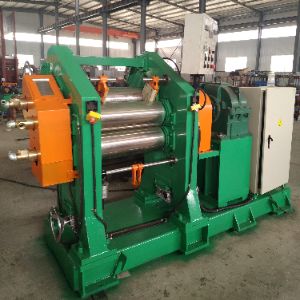
Most discussions of calender lines fixate on roll count or maximum line speed, yet the real step changes happen in less glamorous places. Closed-loop gap control that samples thickness every few milliseconds, combined with heated rolls whose temperature varies by less than a degree across the face, has quietly redefined what “flat” means. Operators used to chase profile errors after the fact; now the line corrects them before a full revolution completes.
Another shift is roll bending compensation that no longer relies on hydraulic guesswork. Finite-element models running in real time predict deflection under varying load and adjust crown or crossed axes dynamically. This keeps nip pressure uniform even when product width changes mid-run, something older lines handled with shims and manual tweaks that cost hours of downtime.
The least visible advance is surface texturing on rolls that resists buildup without sacrificing release. Specialized coatings and micro-patterns extend run lengths between cleanings, which matters more than raw throughput for profitability. Together these details separate a modern calender line from machines that simply look similar on a spec sheet.
Why Calender Machine Innovation Matters More Than Ever in 2025
In 2025, the calender machine sits at the intersection of material science and precision manufacturing. Demands for thinner films, tighter tolerances, and faster changeovers are no longer niche requests—they are baseline expectations across packaging, battery production, and advanced composites. Older machines simply cannot hold the micro-level consistency required by next-generation products, which pushes innovation from a nice-to-have into a survival strategy for many processors.
Market shifts also play a decisive role. Supply chains now favor shorter runs and more frequent material switches, meaning calenders must adapt quickly without sacrificing output quality. This requires smarter controls, modular roll designs, and real-time thickness monitoring that were rare just a few years ago. Facilities that ignore these upgrades risk falling behind on energy efficiency as well, since modern calender drives and heating systems consume far less power per square meter of processed material.
Perhaps the clearest driver is defect reduction. With raw material costs still volatile, every millimeter of wasted film or sheet translates directly into lost margin. Innovative calender features—like automatic gap correction, predictive roll maintenance, and closed-loop tension control—help operators maintain uniform caliper hour after hour. In a year where margins are tighter than ever, the ability to run longer between rejects is a competitive edge that no serious production line can ignore.
Inside a Calender Machine Factory: Where Material Consistency Meets Smart Automation
On the calendering line, a slab of compound feeds through a set of heated rollers that squeeze it into a precise thickness. The gap between those rollers shifts by fractions of a millimeter, and that is where the battle for consistency begins. Operators still run a thumbnail across a freshly cut strip to feel for uneven spots, but they rely less on instinct now. A laser profilometer mounted just after the final nip sends a thickness profile to the control cabinet every half-second, flagging any drift before it becomes a rejected batch.
Smart automation here does not mean replacing the crew; it means giving them better feedback. Roll temperature, motor torque, and feed rate all stream into a process historian. When the system sees a slight rise in roll temperature, it nudges the cooling water valve open a bit rather than waiting for an operator to notice the change in surface gloss. That closed loop keeps the material within a tighter band than manual adjustments ever could, especially on long runs where fatigue used to cause gradual drift.
The result is visible in the stacking area. Finished sheet and film leave the line with fewer gauge bands and fewer surface defects. A single roll may be destined for a medical device gasket or a conveyor belt splice, and the customer expects the same thickness at the core as at the outer wrap. That kind of repeatability comes from measuring the process, not just the product, and letting the automation handle the small corrections while the operators focus on what the sensors cannot see—like a slight color shift in the compound or a change in the way the material releases from the roll.
The Real Drivers Behind Calender Machine Excellence (It’s Not Just Speed)
While throughput metrics dominate conversations about calender machines, the ones that consistently deliver repeatable output earn their reputation elsewhere. Roll alignment tolerances measured in microns, temperature uniformity across the working width, and pressure distribution that remains stable over thousands of cycles separate dependable production from constant troubleshooting.
Another overlooked driver is what happens to the web before and after the nip. Moisture content, tension, and preheating consistency often determine whether a calender adds value or simply moves defects further down the line. Shops that instrument these variables and adjust in real time rarely chase the same problems twice.
Long-term mechanical stability also plays a quiet role. Machines designed with straightforward roll changes and honest maintenance intervals keep variability low. When operators trust the machine to repeat yesterday's settings, they pay attention to product quality instead of babysitting the line.
From Roll Design to Real-Time Analytics: A Look at Factory Floor Breakthroughs
On the modern factory floor, the journey from initial roll design to actionable real-time analytics marks a profound shift in how manufacturing problems are solved. For decades, roll design—whether for metal forming, paper production, or textile processing—was largely a static discipline: engineers optimized geometries and materials at the drafting table, then handed the specifications to the shop floor, where adjustments happened only after defects or downtime made them unavoidable. Today, that linear sequence has collapsed. Sensors embedded in rolls and adjacent machinery now stream data on pressure distribution, temperature variance, vibration signatures, and wear patterns at millisecond intervals. The result is a feedback loop that treats a roll not as a fixed component but as a living source of operational intelligence.
What makes this breakthrough genuinely transformative is the shift from reactive troubleshooting to predictive and prescriptive action. In a traditional setup, a bearing running hot or a surface developing micro-cracks might go unnoticed until product quality suffered or the line stopped. With real-time analytics, the same anomalies trigger immediate alerts and, more importantly, feed algorithms that correlate them with historical failure modes and current production parameters. Engineers can then adjust nip pressure, roll speed, or cooling rates on the fly—sometimes automatically. This closed-loop control reduces scrap, extends roll service life, and prevents cascading failures that once rippled through entire production batches.
Perhaps the most underappreciated consequence is the democratization of expertise on the floor. Rolling processes used to depend heavily on veteran operators who could “feel” when a roll was out of spec through years of tacit knowledge. Now, analytics dashboards translate subtle signal patterns into plain-language guidance, so a junior technician can make decisions with the confidence of a seasoned specialist. At the same time, the collected data becomes a training corpus for machine learning models that uncover non-obvious relationships—between, say, ambient humidity and roll coating adhesion—that even experienced engineers might never have suspected. The factory floor, once a place of brute force and tribal knowledge, is becoming a data-driven environment where every revolution of a roll contributes to a smarter, more resilient operation.
FAQ
It comes down to closed-loop control. Older lines relied on operator feel and periodic sampling, while today's factories use laser-based thickness gauges that feed adjustments back to the roll gaps within milliseconds. That shift alone turns a batch process into something closer to continuous precision manufacturing.
Cross-axis roll bending and independently controlled roll zones. Instead of crowning a roll for one fixed profile, the machine adapts its nip profile in real time based on sensor data. For films under 20 microns, that can mean the difference between a sellable reel and scrap.
Many now use direct-drive motors on each roll, eliminating gearbox losses, and they recover heat from the cooling section to pre-warm feedstock. One plant I'm aware of reduced its energy per kilogram by about 18% just by reusing waste heat from the final embossing station.
Carbide and ceramic-composite coatings now resist wear and chemical attack far better than chrome. That keeps the mirror finish intact longer, so periodic regrinding happens after months instead of weeks, and the product surface stays smooth without constant operator intervention.
Because an unplanned stop on a calender line can cost more than the repair itself. Vibration sensors on bearings and thermal cameras on motors feed models that flag a worn bearing days before it seizes. That lets a factory schedule the fix during a product changeover instead of losing a full shift.
Yes, and that's often where the real advantage shows. A factory making thin silicone sheets for medical tape needs different roll surface temperatures and cooling rates than one producing heavy rubber conveyor belts. Modular roll stacks and swappable embossing stations let a single line switch between those profiles in under an hour.
Ask to see actual thickness-profile logs from a similar product run, not just a spec sheet. A capable factory can show you the deviation band across the full web width over several hours. If they hesitate to share that data, their 'tight tolerance' claim is probably optimistic.
Operators spend less time chasing gauges and more time interpreting trends. The skills shift from manual adjustment to data analysis and process optimization. Many factories now train their best operators on statistical process control, which improves retention because the work feels more like engineering than line tending.
Conclusion
The quiet evolution inside calender machine factories has done more for precision manufacturing than most industry observers realize. Where older lines relied on operator instinct and mechanical repeatability, today’s facilities pair redesigned roll geometries with closed-loop thickness control and live spectral analysis. That combination means a film or sheet product can hold tolerance across an entire shift without constant manual adjustment. It also shifts the conversation away from raw line speed toward something harder to copy: the ability to start a run faster, change formulations without scrapping a full masterbatch, and keep surface finish identical from the first meter to the last. Sensors embedded in the nip and along the cooling train feed data back into the control system, so the machine adjusts crown, gap, and tension before a defect becomes visible downstream.
What makes 2025 a turning point is not a single breakthrough but the convergence of material science, predictive maintenance, and adaptive automation. Calender lines now learn from their own thermal history, compensating for roll expansion or bearing wear in ways that used to require a shutdown. The factories themselves are also changing: fewer manual caliper checks, more inline optical measurement, and a much tighter link between R&D trials and production recipes. None of this makes headlines the way a fully autonomous plant might, but it quietly raises the bar for consistency, yield, and energy use per kilogram. The real driver is control—over the polymer melt, over the roll surface, over the data stream—and that is what separates a modern calender line from the machines that simply ran fast a decade ago.
Contact Us
Contact Person: Chen Zhengwei
Email: [email protected]
Tel/WhatsApp: +86-13963975727
Website: https://www.sfcrubbermachine.com