Custom Horizontal Machining Center Solutions Tailored to Your Production Needs
2026-09-29
When off-the-shelf machining centers force you to compromise on cycle times, part size, or automation, the real bottleneck isn't your production line—it's the machine. That's why WINNRUI CNC builds custom horizontal machining center solutions around your actual workpiece flow, not the other way around. In this post, we'll explore how tailored HMC configurations can reduce setup, expand capacity, and unlock throughput that generic equipment leaves on the table.
Machining Centers Built Around Your Fixtures
Most machine tool builders expect you to adapt your workholding to their machine. That's backwards. We start with the fixtures you already use on the floor and shape the machining center around them—spindle reach, table size, travel, even the chip management—so nothing needs to be reworked just to fit the machine.
This approach pays off quickly if you're running a mix of parts. You keep the same clamping setups you've dialed in over years. No new fixture plates, no shimming, no risky modifications. During the design phase we drop your 3D fixture models right into the layout and check clearances, reach, and tool paths before any metal gets cut.
What you end up with is less time lost resetting jobs and more time with the spindle actually making chips. The machine and fixture act as one unit, so part repeatability improves and the operator doesn't have to fight a mismatch every shift.
Spindle Performance Matched to Your Materials
The right spindle doesn't just spin fast—it delivers the right torque curve, runout tolerance, and thermal stability for the material in front of it. Cutting aluminum at 24,000 RPM with a wood router spindle may sound aggressive, but without enough low-end torque, the tool bogs down in the cut, leaving chatter marks and a poor surface finish. Matching performance to material means reading the chip load, not just the spec sheet.
For plastics and composites, heat is the enemy. A spindle that holds constant speed under load prevents melting and fraying, while a softer acceleration ramp keeps delicate edges from chipping. On dense hardwoods or laminated panels, you need horsepower that doesn't fade when the cutter plunges—paired with a collet system that minimizes runout to under a few microns, otherwise you'll see tearout on the bottom face.
Rather than chasing maximum RPM, look at the whole envelope: peak power, continuous torque, and cooling efficiency. A spindle matched to your most demanding material will run quieter, last longer between bearing replacements, and let you push feed rates without second-guessing tool life. It's not about having the biggest motor—it's about having the right response under real cutting loads.
Pallet Handling That Eliminates Idle Time
Idle time in pallet handling often comes from mismatched rhythms—forklifts waiting on a stacker crane, or a conveyor line stalling because the next station isn't ready. Switching to a continuous-loop pallet system lets each workcell run on actual load demand rather than a fixed cadence, which closes most of those gaps.
Instead of batch releases, some systems use event-driven dispatch: once a pallet's load stabilizes, the next empty pallet is called into the fill position without waiting for operator confirmation. This removes the whole-line waiting that comes from step-by-step handoffs and makes the flow feel almost self-regulating.
Integrated weighing and dimension checks can happen while the pallet is in motion, so there's no separate inspection dwell. Quick-release docking points for forklifts or AGVs further trim exchange times from minutes down to seconds, keeping every pallet in motion instead of parked.
Thermal Stability for Tight Tolerances
When a machine tool warms up, every component expands at its own rate—spindles grow, ballscrews stretch, and castings shift in ways that don't always match the CAD model. For shops holding tolerances under a few microns, that thermal drift can wipe out hours of careful setup before the first good part comes off the line. The usual fix isn't just waiting for the machine to reach a steady state; it's about understanding which parts move and why, then designing the structure and cooling system so the critical dimensions stay put even as the rest of the frame breathes.
One practical approach is to place temperature sensors directly on the spindle housing and the ballscrew nuts, then map those readings to real-time offset corrections in the controller. This isn't a one-time calibration—it's a feedback loop that learns how your specific machine behaves on a cold Monday morning versus a hot Friday afternoon. Another trick is symmetrical design: if the column and base are thermally balanced, the growth cancels out instead of tilting the tool tip. Some builders go further by routing chilled coolant through the core of the casting, not just the spindle, which keeps the entire structure within a degree or two of ambient even during aggressive roughing cycles.
For tight-tolerance work, the test isn't whether the machine can hold size for five minutes after warm-up—it's whether you can walk away for lunch and come back to a part that still measures the same. That means logging thermal error over a full day and comparing it to your tolerance budget. If the spindle grows 8 microns over two hours but your part allows only 5, you need active compensation or a secondary scale on the axis. The best machines on the market now include built-in thermal models that predict drift before it happens, adjusting servo commands preemptively rather than reacting after the error shows up in the part.
Operator-Friendly Controls, Minimal Retraining
A familiar layout is the first thing operators notice. The button clusters stay where they were on the previous generation, and the touch panel keeps the same icon set, so muscle memory carries over almost entirely. No one has to hunt for a hidden submenu just to start a routine cycle.
New hires typically need a single supervised shift before they feel comfortable running the line alone. The on-screen prompts use plain verbs instead of coded abbreviations, and the physical selector switches give a firm click at each position. When a setting is out of range, the display shows the acceptable limits rather than only flashing an error code.
Because the controls don't change from one model year to the next, facilities can move staff between machines without pulling them away for days of classroom training. A short walkaround with an experienced operator covers most questions, and the rest can be picked up during normal production.
Support That Extends Beyond Installation
Real support doesn't stop once the equipment is mounted or the software is running. It starts there. Our team stays within reach for the questions that come up at odd hours, the workflow changes that surface after a few weeks, and the small adjustments that make a big difference in daily use. Expect direct access to people who know the system, not a maze of tickets.
We keep an eye on how things perform over time and reach out when we spot potential trouble before it slows you down. Whether it's a firmware update worth scheduling, a new feature that fits your setup, or just a periodic check-in, the goal is to keep your operation moving without surprises.
When something does need attention, you won't be handed off to someone reading from a script. You'll get clear answers, honest timelines, and if it's urgent, a fix route that makes sense for your environment. That's the difference between a vendor who installs and one who sticks around.
FAQ
It starts with a detailed review of your part geometries, material types, tolerances, and production volumes. From there, the machine's spindle, tool magazine, pallet size, and automation interfaces are configured around those specific requirements rather than forcing your process into a standard package.
Automotive, aerospace, hydraulic equipment, and off-highway machinery manufacturers often see the biggest gains because they frequently run mid-to-high volume parts in tough materials with tight positional tolerances. Job shops with long-term contracts for repeat parts also use custom HMCs to reduce setup time.
The starting point is your largest expected workpiece, including any fixturing clearance and tool reach needed for multi-sided access. We also look at how many parts you want to machine per pallet cycle, which helps balance spindle utilization against changeover frequency.
Yes. Many projects involve matching conveyor height, robot interface points, and control protocols to the equipment already on your floor. The machine can be built with specific coolant guarding, chip disposal routing, and utility connections that align with your current layout.
For aluminum-heavy work, high-speed spindles with lower torque usually make sense; for steel or cast iron, a high-torque geared spindle may be a better match. If your mix shifts frequently, a spindle with a broad speed range and thermal stability features helps maintain accuracy across different cutting conditions.
Usually, your manufacturing engineers and maintenance staff provide input during the specification and design review stages. After installation, operators typically need only a short familiarization period if the control interface and tool management screens are configured to match your naming conventions and workflow.
Support generally includes startup assistance, process prove-out on your actual parts, and operator training. Ongoing service can range from remote diagnostics to scheduled preventive maintenance, with spare parts held based on the custom components used in your build.
A custom HMC often takes longer to deliver because components like special fixtures, tooling interfaces, or automation hardware may need to be sourced or fabricated. However, front-loading the engineering review usually shortens the time to stable production once the machine arrives.
Conclusion
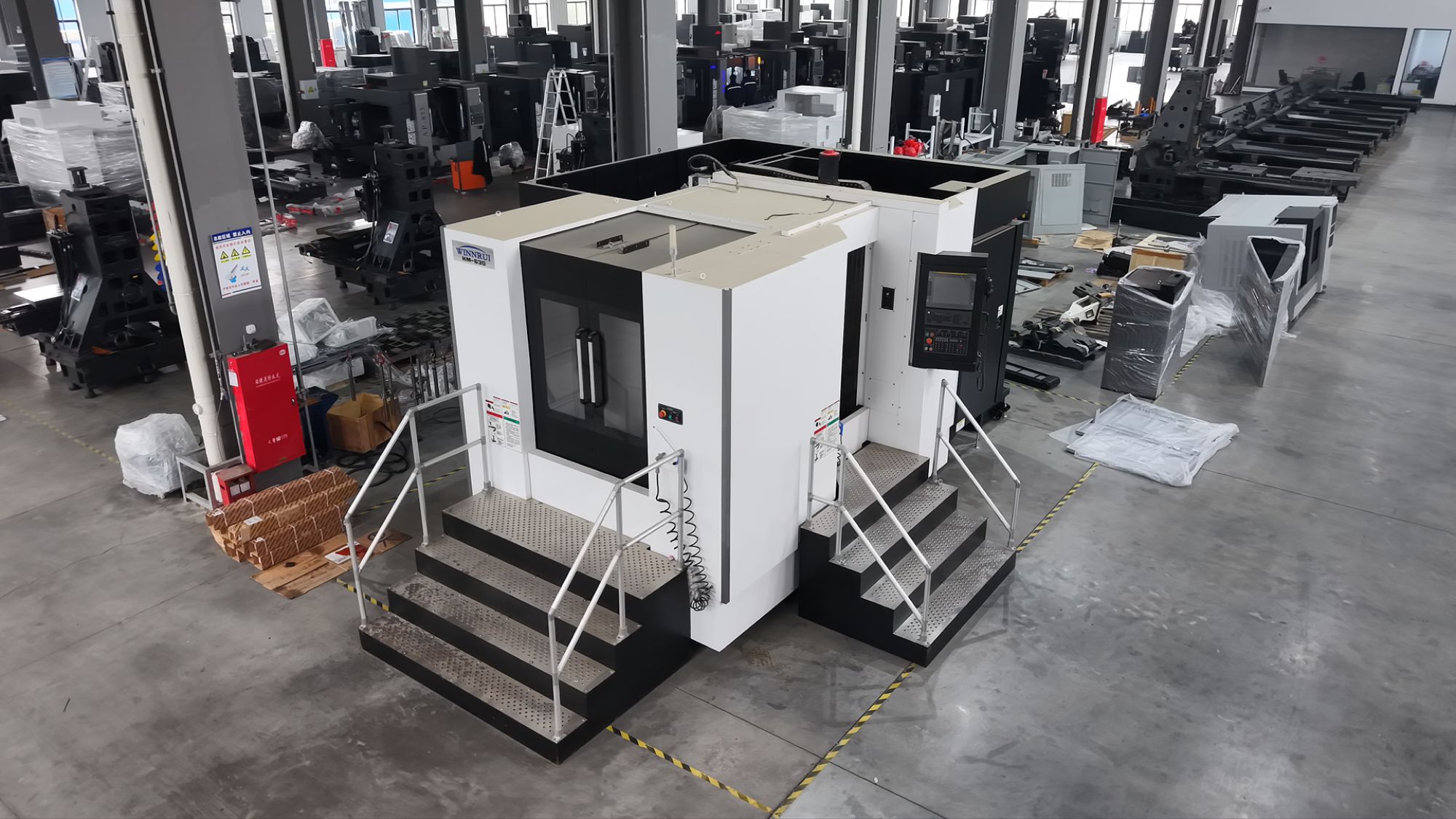
Every production line carries its own constraints, from existing fixture plates to the specific alloys that pass through the spindle. Instead of forcing a standard machine into that environment, these horizontal machining centers are designed outward from your setup. Fixture locations, travel ranges, and column height adapt to the workholding you already trust, so there is no need to redesign clamping systems or accept awkward reach limitations. Spindle options are matched to the materials you actually cut—high-torque units for difficult steels, high-speed spindles for aluminum or composites—so chip loads and cycle times reflect the job, not a catalog compromise. Pallet handling is configured around your workflow: dual pallets, multiple stations, or integrated automation keep the spindle cutting while the next part is staged, removing the idle gaps that quietly erode output.
Thermal behavior is addressed through structural design and controlled cooling rather than relying on software correction alone, allowing tight tolerances to hold across long unattended runs. On the control side, the interface is simplified around the tasks your operators already perform, which reduces retraining and makes first shifts productive sooner. Support extends beyond the installation milestone—application engineers stay involved for process refinement, tooling adjustments, and future production changes. This is not a one-size-fits-all horizontal machining center with optional extras bolted on. It is a planned system that follows the contours of your production needs, from the first fixture loaded to the years of service after ramp-up.
Contact Us
Contact Person: Tim
Email: [email protected]
Tel/WhatsApp: +86 15522553731
Website: https://www.winnrui-cnc.com/