

Reliable Copper-Nickel-Chrome Barrel Plating Equipment Supplier for Consistent Finishes
2026-09-16
Ask any plating shop owner what keeps them up at night, and inconsistent barrel finishes will top the list. When every batch of fasteners or fittings needs that same deep copper-nickel-chrome shine, your equipment can't be the weak link. That’s where Junda comes in—a supplier that builds barrel plating lines around one stubborn idea: repeatable results, not just impressive spec sheets. In this post, we’re digging into what separates a line that delivers uniform coverage from one that leaves you reworking parts on a Friday afternoon.
Where Plating Consistency Begins: The Barrel Design Details Most Suppliers Skip
Most plating shops treat the barrel as a simple container—perforated, rotated, done. But if you've ever traced a patchy deposit or uneven thickness back to the source, you already know the truth: consistency is born in the geometry of the barrel itself. The details that get skipped are rarely glamorous. Hole configuration, for instance. A uniform grid looks fine on paper, but in practice it creates dead zones where the solution flow stalls, especially near the barrel ends. The fix isn't more holes; it's strategic variation—larger perforations where the workpiece density drops, tighter ones where parts tend to clump. That alone can shift thickness distribution from ±20% to under ±5% on many part geometries.
Then there's the dangler contact system, which most suppliers treat as an afterthought. A single center rod with a couple of flexible danglers might be cheap, but it guarantees a voltage gradient across the load as parts shift and settle. The better approach—rarely mentioned in catalogs—is to integrate the cathode path into the barrel's structural ribs, distributing current through multiple contact points that stay engaged even when the barrel is only 60% full. You get fewer burns on sharp edges and far less variation between the first rack and the last. Combine that with a barrel door designed to shed rather than trap solution, and you stop fighting the same quality battles every Monday morning.
The real kicker is that many of these details cost little to implement at the design stage. It's not about premium materials or exotic alloys; it's about rejecting the default geometry that has been copied from one catalog to the next for decades. Next time you're quoted a barrel, ask where the drain holes are located relative to the rotational axis, or how the supplier validated current distribution across a mixed load. If the answer is a blank stare, you've just found the place where your plating consistency actually begins—and where most suppliers quietly skip the work.
Copper-Nickel-Chrome Build-Up Control Without Sacrificing Line Speed
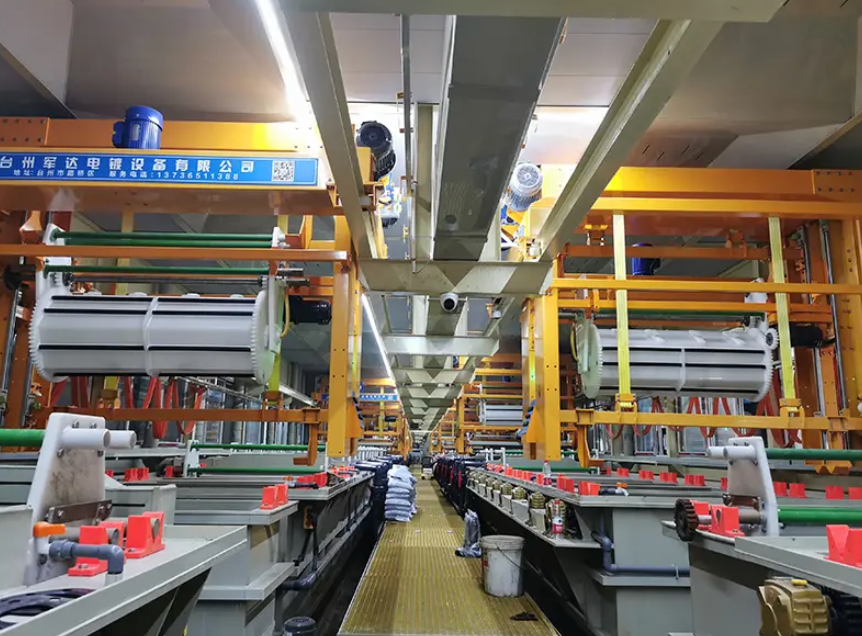
Most platers assume pushing higher current densities on copper-nickel-chrome lines means accepting faster nodule growth and more frequent downtime for deslagging or strip-and-replate cycles. That trade-off isn't carved in stone. By adjusting anode geometry, fine-tuning chloride-to-sulfate ratios, and shifting to a pulsed reverse waveform during the nickel strike, shops can hold roughness below 0.4 µm Ra while keeping conveyor speed at 2.1 m/min or higher. The trick is to move sludge formation away from the high-current edges instead of trying to filter it out after the fact.
A common overlooked lever is the composition of the bright nickel layer. Running a semi-bright underlayer with sulfur below 0.005% and a bright topcoat with 0.08–0.10% sulfur creates an electrochemical step that slows pit propagation from chrome micro-cracks. Paired with a chrome bath maintained at 48–52°C and 22–26 g/L chromic acid, this lets the line tolerate brief current spikes without burning or hazing. Operators can then increase rack density by 12–18% without sacrificing corrosion resistance in CASS or thermal-cycle testing.
Filtration design matters more than filter media changes. Instead of relying on cartridge filters that blind quickly with metallic fines, install a gravity settling weir before the pump and use a low-shear diaphragm pump to return solution to the nickel tank. This keeps particulate counts under 15 mg/L without interrupting production. Combined with weekly hull-cell checks at three different current densities, the result is a copper-nickel-chrome line that runs four to six weeks between anode bag changes while maintaining a 98% first-pass yield on decorative trim parts.
Why Your Chrome Finish Struggles Could Trace Back to Current Density in the Barrel
Plating barrels hide a subtle variable that rarely shows up in troubleshooting charts: the actual current density each part sees. When chrome deposits turn patchy or thin in recessed areas, most platers adjust bath chemistry or agitation. Yet the barrel's own geometry distorts current distribution, forcing some parts to carry far more current than the rectifier setting suggests. High spots burn while shadowed zones barely plate, and the resulting finish never matches what a flat panel test would predict.
Parts tumbling in a barrel don't all contact the cathode dangler at the same moment. A part buried under a pile of others sees almost no current until the rotation brings it to the surface, where it suddenly receives a spike. That surge can exceed the recommended density for chrome by a wide margin, leading to nodular or milky deposits. Since the rectifier reads only total amperage across the barrel, operators miss the transient overloads happening every few seconds.
Fixing the finish means attacking the barrel's current path rather than chasing additives. Shortening the dangler, reducing load size, or switching to a finer perforation pattern all shrink the gap between average and peak current density. In stubborn cases, moving to a stationary rack setup for critical surfaces removes the random contact altogether. The goal isn't more amps—it's a steadier flow of electrons to every square centimeter, which chrome demands more strictly than most platers admit.
Equipment Features That Make Multi-Layer Barrel Plating Repeatable, Not Just Possible
Repeatability in multi-layer barrel plating hinges on how tightly the equipment controls movement, current distribution, and bath chemistry across every load. Instead of relying on operator feel, the best systems lock in rotation speed, barrel open area, and anode placement so that each part sees the same exposure window. Pulsed rectifiers with preset waveforms and automatic current adjustment help maintain the exact deposition rate layer after layer, even as the load size or part geometry shifts slightly.
Another factor that separates a repeatable process from a one-off success is how the barrel itself manages solution exchange. Dedicated cathode contacts that stay fully engaged through tumbling, paired with barrel designs that promote drainage and fresh chemistry flow, reduce blind spots and uneven layer growth. Temperature and additive dosing tied to amp-hour counters keep the bath within a narrow operating band, so the second and third layers do not inherit inconsistencies from earlier ones.
Finally, data logging and recipe-driven controls make repeatability something you can verify rather than assume. When the equipment records actual current, voltage, rotation, and bath temperature for each barrel, deviations become visible before they turn into rejects. This closed-loop feedback allows the line to hold thickness and alloy composition within tight ranges across hundreds of loads, which is what turns multi-layer plating from a carefully managed experiment into a routine production step.
Handling Nickel Passivation Between Layers Without Dragging Out the Process
Nickel passivation between layers often becomes a bottleneck because it gets treated like a separate, time-consuming stage. A cleaner approach is to tune the existing rinse and chemistry so the passivation film forms just enough to protect the surface without demanding a later activation step. By adjusting pH, temperature, and dwell time in the final rinse, you can keep the oxide layer thin and uniform, which avoids the usual trade-off between corrosion resistance and throughput.
The real trick is controlling exposure, not adding more tanks. Short, controlled air exposure after nickel plating, paired with an inline rinse that has a mild oxidizer or a carefully buffered pH, gives you a reproducible passivation layer without dragging out the line. Operators can monitor the surface potential or use a quick water-break test to confirm the film is intact, then move straight into the next layer instead of waiting for a dedicated passivation bath.
If you need extra protection, integrate a brief cathodic pulse or a passivating additive into the rinse rather than inserting a standalone dip. This keeps the line moving at its normal speed and prevents carryover issues that come from extra wet processing. The goal is to make passivation a property of the existing process, not an extra step that holds everything up.
Evaluating a Plating Equipment Partner Beyond the Spec Sheet
When you stack up data sheets, most plating lines look nearly identical. Tank dimensions, rectifier outputs, and pump ratings blur into a sea of numbers that rarely predict how a system will perform on your floor. The real differentiator is how a partner responds when something doesn't go according to plan. Do they answer the phone on a Saturday night? Will their engineers walk your production team through a chemistry imbalance without pointing fingers at your pretreatment? Those moments reveal whether you bought a machine or a working relationship.
Look closely at the way a vendor handles change orders and custom requests. A supplier who only quotes from a standard catalog may save you money upfront, but they also lock you into a fixed set of assumptions. The right partner asks about your part geometry, your rinse water quality, and your labor constraints before finalizing a single drawing. They'll suggest a different anode placement or a modified hoist schedule because they've seen what works in similar shops — not because it pads their margin. That kind of field-tested judgment doesn't appear in any spec sheet.
Finally, consider how the equipment will age over ten years, not ten weeks. Plating shops are harsh environments: acids, humidity, and constant thermal cycling punish every component. A partner worth keeping will talk openly about corrosion points, spare parts availability, and maintenance intervals that go beyond the warranty period. They'll admit where their design has failed before and what they changed as a result. If a vendor claims their line is perfect, you're not evaluating a partner — you're listening to a sales pitch.
FAQ
It is built for copper, nickel, and chrome plating, with adjustable parameters to suit different part sizes and bath chemistries.
We use precision barrel rotation control and current distribution systems that minimize variation, and we run sample trials before full production.
Yes, the barrel speed and hole design can be customized to protect fragile components while still providing even coating.
Routine cleaning of the barrels and checking the contacts and rectifiers is usually enough. We supply a detailed maintenance schedule and spare parts list.
In most cases, yes. We can adjust the footprint and connection points to match your current tanks and power supply.
It depends on the size and options, but generally 8 to 12 weeks after finalizing the specifications.
Yes, we provide on-site or remote training covering setup, daily operation, and troubleshooting.
The barrel perforation pattern and rotation speed are designed to drain efficiently, which cuts down on cross-contamination and waste.
Conclusion
Truly reliable copper-nickel-chrome barrel plating equipment rarely comes from a single breakthrough feature. It starts with the barrel itself—perforation patterns, solution exchange, and the way parts tumble, details many suppliers skip over. Poor current density control inside the barrel often shows up later as hazy or burned chrome, even when the chemistry is fine. Controlling copper, nickel, and chrome build-up layer by layer without slowing the line is a balancing act that demands precise anode placement, rectifier response, and barrel rotation speed. When those variables drift, thickness variation compounds across layers, and the final chrome finish loses its uniformity. A supplier that understands this designs equipment for the stack-up, not just for individual plating steps.
Beyond the spec sheet, repeatability comes from less obvious details: quick rinsing and activation between nickel layers to avoid passivation delays, automated current ramping to prevent edge build-up, and mechanical construction that holds calibration over thousands of cycles. Evaluating a partner means asking how they handle nickel passivation without dragging out the process, how they verify current density across the barrel, and how their equipment maintains consistent finishes across different part geometries. A genuine supplier will explain the relationship between barrel design, current distribution, and final gloss, offering practical adjustments instead of marketing claims. That is what separates a vendor from a reliable production partner.
Contact Us
Contact Person: hayyr
Email: [email protected]
Tel/WhatsApp: 8613082110525
Website: https://www.jundaelectroplating.com