
How Endotracheal Tube Design Ensures Safe Mechanical Ventilation Delivery?
2026-10-21
A respiratory therapist is managing a patient on mechanical ventilation. The ventilator alarms show a high peak airway pressure. The therapist checks the Endotracheal Tube. The tube is kinked at the connector, and the cuff pressure is 45 cm H₂O, which is above the recommended range. The high cuff pressure is compressing the tracheal mucosa, and the kink is increasing the resistance to airflow. The therapist repositions the tube, adjusts the cuff pressure to 25 cm H₂O, and the airway pressure returns to normal. This scenario illustrates why endotracheal tube design matters. The tube is not just a conduit. It is a critical component of the ventilation system, and its design features determine whether the ventilation is delivered safely and effectively. This guide explains the design features that ensure safe mechanical ventilation.
1. How Does Cuff Design Affect Airway Seal and Mucosal Safety?
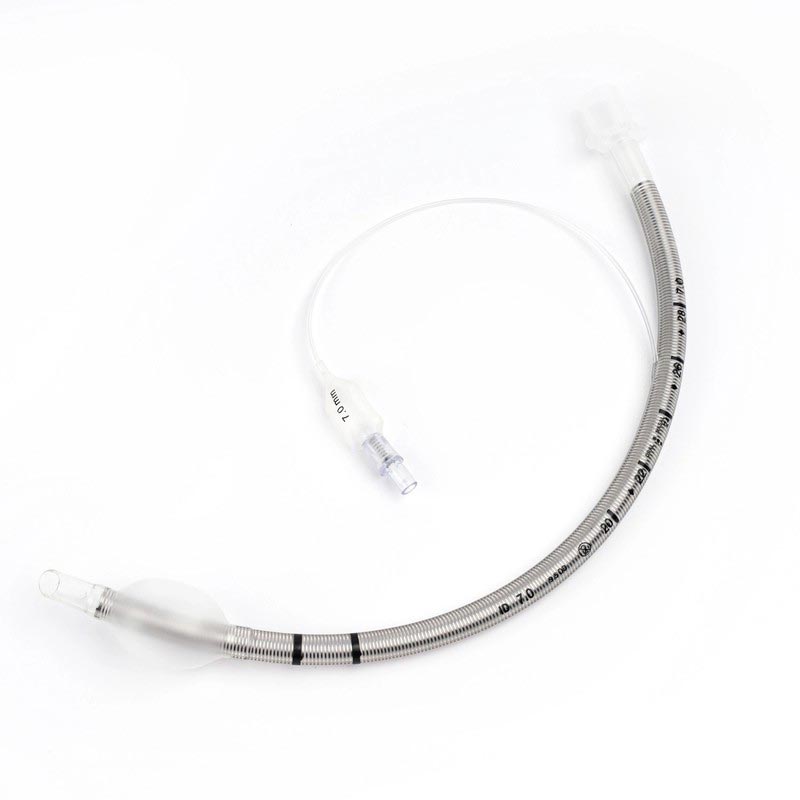
The cuff is the inflatable balloon near the distal end of the Endotracheal Tube. It seals the trachea so that the positive pressure from the ventilator does not leak out around the tube. The cuff must maintain a seal at the lowest possible pressure to avoid damaging the tracheal mucosa. The mucosal blood pressure is approximately 25 to 35 cm H₂O. If the cuff pressure exceeds this range for an extended period, the blood flow to the mucosa is reduced, which can lead to ischemia, ulceration, and tracheal stenosis. The table below shows the relationship between cuff pressure and mucosal blood flow.
| Cuff pressure (cm H₂O) | Mucosal blood flow | Risk of ischemia | Seal quality |
| 15 – 20 | Normal | Low | May leak at high airway pressure |
| 20 – 25 | Slightly reduced | Low | Good seal for most ventilation |
| 25 – 30 | Reduced | Moderate | Good seal at high airway pressure |
| 30 – 40 | Significantly reduced | High | Good seal but mucosal damage |
| > 40 | Near zero | Very high | Tracheal necrosis risk |
In our factory, we manufacture Endotracheal Tube units with high-volume, low-pressure cuffs. The cuff is made from a thin, compliant polyurethane film that conforms to the tracheal wall at a pressure of 20 to 25 cm H₂O. We also offer a cuff pressure monitoring line that allows the therapist to verify the pressure without disconnecting the circuit. Tianjin Hanteng Shengye Technology Co., Ltd. has been manufacturing endotracheal tubes for over 12 years.
2. How Does Tube Internal Diameter Affect Airway Resistance and Work of Breathing?
The internal diameter of the Endotracheal Tube determines the resistance to airflow. A smaller diameter increases the resistance, which increases the work of breathing for the patient and the pressure required from the ventilator. The resistance is inversely proportional to the fourth power of the radius, according to the Hagen-Poiseuille equation. This means that a small reduction in diameter causes a large increase in resistance. The table below shows the resistance and work of breathing for different tube sizes.
| Internal diameter (mm) | Resistance (cm H₂O/L/s) | Work of breathing (J/L) | Typical patient |
| 6.0 | 12 – 15 | 0.8 – 1.0 | Small adult, female |
| 7.0 | 7 – 9 | 0.5 – 0.7 | Average adult, female |
| 7.5 | 5 – 7 | 0.4 – 0.5 | Average adult, male |
| 8.0 | 4 – 5 | 0.3 – 0.4 | Large adult, male |
| 8.5 | 3 – 4 | 0.2 – 0.3 | Very large adult |
Respiratory therapist's note: The tube size should be the largest that can be safely inserted. A larger tube reduces the work of breathing and allows for easier suctioning and bronchoscopy. However, a tube that is too large can cause trauma during insertion. In our factory, we recommend that the therapist select the tube size based on the patient's height, sex, and clinical condition. We provide a sizing guide with every Endotracheal Tube order. We also offer a tube with a reinforced wire coil that prevents kinking, which is especially useful for patients who are positioned prone or who move frequently.
3. How Does Subglottic Drainage Reduce the Risk of Ventilator-Associated Pneumonia?
Ventilator-associated pneumonia (VAP) is a common complication of mechanical ventilation. It occurs when secretions that accumulate above the cuff leak into the lower airways. The secretions contain bacteria that colonize the airway and cause infection. A subglottic drainage tube has a separate lumen that opens above the cuff. The therapist can suction the secretions from this area without interfering with the ventilation circuit. The table below shows the effect of subglottic drainage on VAP rates.
| Tube type | VAP rate (cases per 1,000 ventilator days) | Reduction | Typical application |
| Standard tube (no drainage) | 12 – 18 | Baseline | Short-term ventilation |
| Subglottic drainage tube | 5 – 8 | 50 – 60% | Expected prolonged ventilation (> 48 hours) |
In our factory, we manufacture Endotracheal Tube units with a subglottic drainage lumen. The lumen is embedded in the tube wall and does not increase the outer diameter. The drainage port is located just above the cuff and is designed to aspirate secretions effectively. We also provide a dedicated suction catheter that fits the drainage lumen. Tianjin Hanteng Shengye Technology Co., Ltd. recommends the subglottic drainage tube for patients who are expected to require mechanical ventilation for more than 48 hours.
4. What Other Design Features Contribute to Safe Ventilation?
Several other design features contribute to the safety of mechanical ventilation. The first is the Murphy eye, which is a small hole near the tip of the tube. If the main lumen becomes blocked by secretions or by the tracheal wall, the Murphy eye provides an alternative path for airflow. The second is the radiopaque line, which allows the therapist to verify the tube position on a chest X-ray. The third is the depth markings, which help the therapist determine the insertion depth. The fourth is the connector, which must be compatible with the ventilator circuit and must not obstruct the lumen. The table below summarizes these features.
| Feature | Function | Verification method |
| Murphy eye | Alternative airflow path if main lumen blocked | Visual inspection; flow test |
| Radiopaque line | Verifies tube position on X-ray | Chest X-ray |
| Depth markings | Determines insertion depth | Visual inspection at insertion |
| Connector | Connects to ventilator circuit | Pull test; compatibility check |
| Reinforced wire coil | Prevents kinking | Visual inspection; bend test |
In our factory, we test every Endotracheal Tube for the patency of the Murphy eye, the continuity of the radiopaque line, and the security of the connector. We also test the tube for kink resistance by bending it to a 90-degree angle and measuring the reduction in internal diameter. The diameter must remain at least 90 percent of the original. Tianjin Hanteng Shengye Technology Co., Ltd. provides full test reports with every batch of tubes.
Frequently Asked Questions About Endotracheal Tube Design and Mechanical Ventilation
Summary for Respiratory Therapists and ICU Teams
The design of an Endotracheal Tube directly affects the safety and effectiveness of mechanical ventilation. The cuff design determines the seal and the mucosal safety. The internal diameter determines the airway resistance and the work of breathing. The subglottic drainage lumen reduces the risk of VAP. The Murphy eye, radiopaque line, depth markings, and connector contribute to safe placement and operation. By understanding these design features, respiratory therapists can select the right tube for each patient and manage the ventilation safely. Tianjin Hanteng Shengye Technology Co., Ltd. has been manufacturing Endotracheal Tube units for over 12 years and provides full technical support for our customers.
Tianjin Hanteng Shengye Technology Co., Ltd. manufactures Endotracheal Tube units with high-volume low-pressure cuffs, subglottic drainage lumens, reinforced wire coils, and Murphy eyes. We provide cuff pressure gauges, suction catheter sizing charts, and test reports for all of our products.