
Why Does an Anesthesia Circuit Kit Include a CO₂ Absorber Canister
2026-06-16
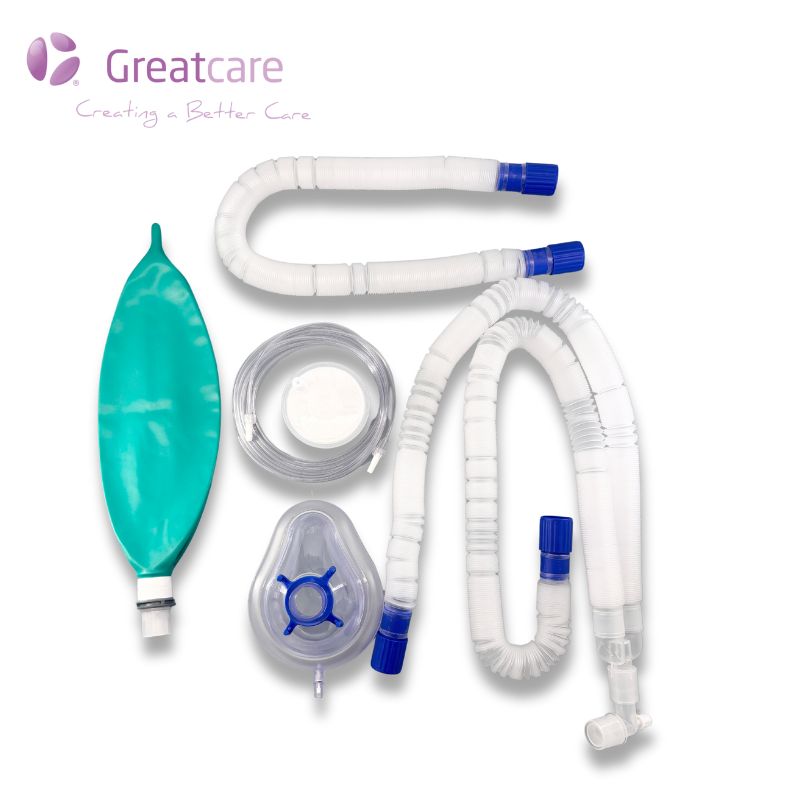
In modern anesthesia delivery, every component of an Anesthesia Circuit Kit serves a vital purpose. The CO₂ absorber canister is not an accessory—it is a core safety device. GreatCare, a trusted name in airway management, designs its Anesthesia Circuit Kit to optimize gas flow while preventing rebreathing of carbon dioxide. Understanding the science behind the canister helps clinicians reduce risks and improve patient outcomes.
The Physiological Basis for CO₂ Removal
During general anesthesia, the patient’s exhaled gas contains approximately 4–5% CO₂. Without removal, rebreathing leads to hypercapnia, acidosis, and cardiac instability. A circle breathing system reuses exhaled gases to conserve humidity and anesthetic agents. The CO₂ absorber canister chemically binds with CO₂, allowing the remaining oxygen and volatile anesthetics to be safely recirculated.
Key Functions of the CO₂ Absorber in an Anesthesia Circuit Kit
| Function | Clinical Benefit |
|---|---|
| Prevents CO₂ rebreathing | Avoids hypercapnia and respiratory acidosis |
| Preserves anesthetic gases | Reduces waste and lowers operating costs |
| Maintains circuit integrity | Supports low-flow and closed-loop anesthesia |
| Protects breathing filters and sensors | Prevents contamination and extends equipment life |
How the Canister Works: A Professional Breakdown
Most GreatCare Anesthesia Circuit Kits use a transparent, refillable canister containing soda lime or similar absorbent material. The chemical reaction:
CO₂ + H₂O → H₂CO₃ → neutralization with calcium hydroxide.
Exhaled gas passes through the canister before re-entering the inspiratory limb. Color indicators in the absorbent change from white to purple when exhausted, signaling replacement need.
Common Mistakes Clinicians Should Avoid
-
Using an exhausted canister beyond its color change limit.
-
Failing to check canister seal, leading to circuit leaks.
-
Overpacking absorbent, which increases resistance to breathing.
-
Ignoring heat generation—CO₂ absorption is exothermic and can warm inspired gases.
Anesthesia Circuit Kit FAQ – Common Questions Answered
Q1: How long does a CO₂ absorber canister last inside an Anesthesia Circuit Kit during routine surgery?
A1: Duration depends on fresh gas flow rate, patient size, and metabolic rate. For a typical adult under low-flow anesthesia (1 L/min), a standard 900g soda lime canister lasts 6–10 hours. Under high-flow (3–5 L/min), lifespan drops to 2–4 hours. GreatCare recommends monitoring the color indicator and replacing the canister before every prolonged case or when 50–70% of the granule changes color. Never rely solely on time—always verify with capnography.
Q2: Can I use an Anesthesia Circuit Kit without a CO₂ absorber canister in an emergency?
A2: No. Removing the CO₂ absorber forces the circuit into non-rebreathing mode, which requires a high fresh gas flow (≥5–8 L/min) to wash out exhaled CO₂. Even then, the risk of valve malfunction or accidental rebreathing remains. For emergency situations, switch to a Mapleson circuit designed for high-flow without an absorber. In a standard circle system, the GreatCare Anesthesia Circuit Kit must retain a functional, non-exhausted canister to prevent life-threatening hypercapnia within minutes.
Q3: How do I detect CO₂ absorber failure in an Anesthesia Circuit Kit before patient harm occurs?
A3: Use three independent checks:
-
Capnography waveform – Inspiratory CO₂ above zero indicates channeling or exhausted absorbent.
-
Color indicator – Compare fresh absorbent with the canister’s bottom layer; any purple zones mean depletion.
-
Temperature test – An exhausted canister will feel cool, while active absorption generates warmth (35–45°C).
GreatCare kits include a clear canister body and printed color guide for rapid visual verification. If inspiratory CO₂ exceeds 5 mmHg, replace the canister immediately.
Best Practices for Safe Usage
-
Perform a pre-use leak test of the entire Anesthesia Circuit Kit.
-
Document canister replacement time and gas flow settings.
-
Use a heat-and-moisture exchanger (HME) upstream to reduce canister desiccation.
-
Follow GreatCare guidelines for absorbent granule density—do not tamp.
Optimize Your Anesthesia Workflow with GreatCare
The CO₂ absorber canister transforms an Anesthesia Circuit Kit from a simple conduit into a safe, efficient circle system. By integrating transparent housing, low-resistance granules, and standardized connections, GreatCare ensures that every kit supports predictable CO₂ control, lower anesthetic waste, and enhanced patient safety.
Contact us today at GreatCare to request a product sample or schedule a clinical evaluation of our Anesthesia Circuit Kit range. Our team provides technical datasheets, in-service training support, and volume-based supply solutions tailored to your department’s needs.