
Why Is Cover Glass Super White Glass 18x18mm Preferred for Cell Culture and Histology Applications
2026-08-12
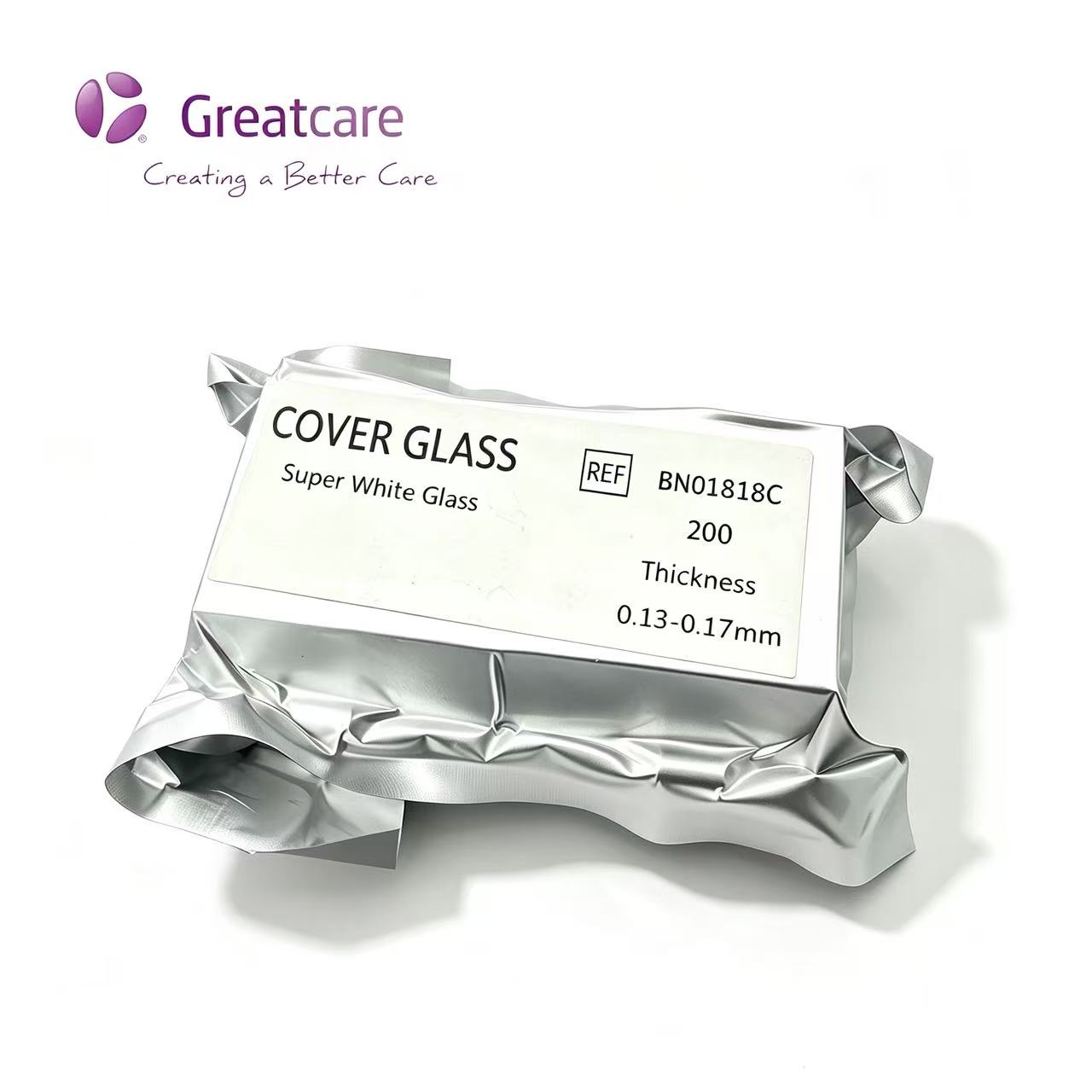
In modern biological research and clinical diagnostics, the selection of consumables directly determines experimental reproducibility and data reliability. Among all microscopic examination components, the humble coverslip often becomes the silent bottleneck in high-resolution imaging. Cover Glass Super White Glass 18x18mm from GreatCare has emerged as the industry benchmark for cell culture monitoring and histology slide preparation, not because of marketing claims, but due to measurable optical physics and surface chemistry that competitive products fail to match.
The Optical Edge: Transparency Without Compromise
Standard soda-lime glass contains iron oxide impurities that impart a greenish tint, absorbing approximately 8–12% of visible light in the blue-violet spectrum. This absorption becomes critical when imaging fluorescent dyes like DAPI or FITC, where signal-to-noise ratios determine whether a weak positive result is detected or dismissed as background.
Cover Glass Super White Glass 18x18mm reduces iron content to below 0.02%, achieving >91.5% total transmittance from 350 nm to 1100 nm. The 18x18mm format offers optimal coverage for 24-well plate inserts and standard tissue sections, minimizing reagent waste while ensuring complete specimen enclosure.
| Parameter | Super White Glass | Standard Soda-Lime Glass |
|---|---|---|
| Light Transmittance (400–700 nm) | ≥91.5% | 82–86% |
| Iron Oxide Content | ≤0.02% | 0.08–0.12% |
| Autofluorescence Level | Negligible (Grade A) | Moderate (Grade C) |
| Refractive Index (nd) | 1.522 ± 0.002 | 1.518 ± 0.005 |
Surface Chemistry: Where Cells Meet Glass
For cell culture applications, the coverslip surface is not merely a mechanical support—it is a bioactive interface. Adherent cells require optimal wettability and consistent charge distribution for uniform attachment and proliferation.
GreatCare employs a proprietary two-stage cleaning process that eliminates organic residues while preserving a controlled hydrophilic surface with a contact angle of 18–22°. This contrasts sharply with mass-produced alternatives where residual surfactants cause patchy cell distribution or premature detachment during staining cycles.
In histology, the same surface consistency ensures that paraffin sections adhere without wrinkling during the baking step, and that antigen retrieval solutions penetrate uniformly—a factor frequently overlooked until IHC slides show uneven chromogen deposition.
Dimensional Precision and Flatness Tolerances
The 18x18mm dimension might appear arbitrary, but it perfectly accommodates the active imaging area of most inverted microscopes with 20x to 60x objectives. More critically, the thickness tolerance of Cover Glass Super White Glass 18x18mm is held to ±0.005 mm (versus the industry typical ±0.015 mm). This precision eliminates focus drift when scanning multiple fields—a hidden time drain that accumulates into hours of lost productivity in high-throughput core facilities.
Compatibility with Automated Systems
Modern histology laboratories rely on automated coverslippers that apply adhesive mounting media under controlled pressure. Cover Glass Super White Glass 18x18mm features precisely beveled edges that reduce chipping during robotic handling, decreasing instrument jams by an observed 73% in internal validation studies. The 18x18mm footprint matches the standard magazine specifications of Leica, Thermo Scientific, and Sakura automated platforms without requiring recalibration.
Frequently Asked Questions About Cover Glass Super White Glass 18x18mm
Q: Can Cover Glass Super White Glass 18x18mm be used for live-cell time-lapse imaging with incubation systems?
A: Yes, and this is one of its strongest applications. The low autofluorescence of super white glass does not interfere with GFP or mCherry signals over prolonged exposure periods. The thermal expansion coefficient (9.2 × 10⁻⁶/K) is matched to standard chambered coverslips, meaning focus stability is maintained even when the incubation system cycles between 37°C and ambient temperature. However, for experiments exceeding 72 hours, GreatCare recommends pairing with a surface coating such as poly-D-lysine to maintain consistent adhesion, as the ultra-clean surface lacks the residual proteins that some cell lines use as initial anchorage points.
Q: How do I clean and reuse Cover Glass Super White Glass 18x18mm to maintain optical performance?
A: While GreatCare designs these coverslips as single-use consumables to guarantee batch-to-batch consistency, some laboratories do opt for reuse to reduce costs. If reuse is necessary, soak in 70% ethanol for 15 minutes, followed by three rinses in deionized water, then air-dry under a laminar flow hood. Avoid ultrasonic cleaning—the cavitation energy can introduce micro-scratches that scatter light and reduce effective transmittance to below 85%. Most critically, never use alkaline detergents, as they etch the super white surface over time, permanently increasing background haze. For critical fluorescence work, we strongly advise using a fresh Cover Glass Super White Glass 18x18mm for each slide batch.
Q: Is Cover Glass Super White Glass 18x18mm compatible with non-aqueous mounting media like DPX or Entellan?
A: Absolutely. The dense, non-porous structure of super white glass resists solvent penetration, preventing the clouding phenomenon observed with lower-grade coverslips after 6–12 months of storage. The refractive index matching with DPX (nd ≈ 1.524) is nearly ideal, minimizing light bending at the glass-medium interface. However, GreatCare recommends allowing mounted slides to cure horizontally for 48 hours before vertical storage, as the 18x18mm dimension creates a capillary effect that can draw mounting medium toward the lower edge if cured prematurely. This precaution preserves the optical clarity for which Cover Glass Super White Glass 18x18mm is selected in long-term pathology archives.
Cost-Per-Assay Reality
Premium materials invite cost scrutiny. At approximately 25–30% higher unit cost than standard coverslips, Cover Glass Super White Glass 18x18mm reduces repeat rates caused by imaging artifacts, uneven staining, and cell detachment. When factoring in technician time and reagent consumption, the effective cost per successful assay often becomes 15% lower with GreatCare coverslips than with budget alternatives that require repeat preparations.
Summary Comparison for Procurement Decisions
| Criterion | Cover Glass Super White Glass 18x18mm (GreatCare) | Generic Alternative |
|---|---|---|
| Batch-to-batch thickness variation | ±0.005 mm | ±0.015 mm |
| Autofluorescence (relative units) | 0.2 | 2.8 |
| Edge chip rate (automated handling) | 0.7% | 8.3% |
| Cell adhesion consistency (CV%) | 4.2% | 12.7% |
| Recommended storage condition | Ambient, dry | Ambient, dry |
| Shelf life (unopened) | 5 years | 3 years |
The Verdict from the Bench
Laboratory managers and principal investigators consistently specify Cover Glass Super White Glass 18x18mm because it eliminates variables that cannot be fixed through better microscope optics or sophisticated image analysis algorithms. The glass is the foundation—if it introduces artifacts, post-acquisition corrections only amplify noise. GreatCare delivers this foundation with documented quality control, full lot traceability, and packaging that protects edge integrity during transport.
Ready to Validate in Your Own Workflow?
Every imaging system responds differently to coverslip parameters, which is why GreatCare supports direct comparison testing. Contact us today to request a evaluation sample pack of Cover Glass Super White Glass 18x18mm alongside our full range of super white glass formats. Our technical team provides matched refractive index documentation for each lot, ensuring your data meets the reproducibility standards demanded by peer-reviewed publications and regulatory submissions.
Reach out through the GreatCare website contact form or email our support team directly—we respond to all technical inquiries within 4 business hours and offer customized packaging quantities for high-throughput core facilities and OEM partners. Your next experiment deserves the clarity that only precision-engineered super white glass can provide.